"Signs to be meaningful, require interpretation, and Richard and Ogden conclude that sign interpretation is conditioned by the situations in which the sign has been experienced. Meaning therefore inheres not in words themselves but in the remembered contexts in which they have appeared to the interpreter" (p. 1190).
This is a postmodern experiment in sign reading...
The following are close up photos of the underside of Lone Star bottle caps. Lone Star is a cheap Texas lager with clever/hard image puzzles on the undersides of the bottle caps. I think it is interesting that the interpretations of the signs may vary depending on how far into the bottle (or how many bottles) the interpreter is- thus changing the meaningfulness of the signs due to the change in context and situations in which they are experienced.
If you wish, to fully enroll in the experiment, and to enhance the "situations in which the sign has been experienced" and the contexts in which they have appeared", try turning this post into a drinking game (fitting with the medium) and see how well you interpret these "signs" in an incrementally intoxicated "context".
Scroll to the end of the post for the solutions.
Enjoy!
SOLUTIONS!
1. As time goes by
2. Music to my ears
3. May I have this dance?
4. I left my heart in San Francisco
5. Too each his own
6. Pass the buck
7. Hang on to your hats
8. You better look twice
The image credit... and solutions is from here (plus they have a few hundred more of them if you have the time).
"Television not only altered the ways in which public discourse was conducted, but it began to call increasing attention to the problem of what it might mean to be a 'public,' as well as to the problem of how public discourse was received and interpreted by the mass and multiple audiences that attended to it" (pp 8)
This got me to thinking about how television has impacted political rhetoric (this and the recent debates).
This is the first televised presidential debate-
This is interesting commentary on the debate-
I believe the last point about the difference between the radio audience and the television audience is very pertinent to the above quote.
At the time of the first televised presidential debate, there was little research into how audiences received messages and no research about how audiences received political messages like debates on television.
At the time, the magic bullet theory (AKA the hypodermic needle theory), contended that whatever the media produced (like an advertisement or political message) was taken as fact and received wholly. This is why some old television advertisements are so hokey-
Some contend that this misunderstanding of media's impact and power to be received, may play a very large role in the 1960 results.
In respects to the text, the approach to modern rhetoric in media is changing. "In the modern worldview, the universe is a relatively simple, stable, highly ordered place, described in and reducible to absolute formulas that hold across contexts" (pp 11). But, "By contrast, postmodernism prefers interpretation over scientific study because it operates with the assumption that all knowledge is subjective and/or intersubjective, morally culpable, and local. In the postmodern worldview, the universe is a rapidly changing, highly complex entity" (pp11).
In the context of rhetoric(mainly political) being filtered via media, we are in a period much like the 1960 election. This change in media being the Internet. It first began to reveal it's influence and power as rhetorical vehicle in the 2004 election through the sudden shift in popularity for presidential nominee Howard Dean. Dean's awkward victory holler quickly made the rounds online and possibly may have cost him the ticket. This is the holler.
Here are a few examples of what happened.
and this,
and finally this,
Where television used to be a media vehicle that was modern, more stable and controlled, rhetoric is now in a new landscape that is constantly changing and uncontrollable.
I will end with this. Marshall McLuhan is a media theorist(debatable) who had a few theories about television when it first came on the scene. He credited Nixon's loss to JFK to Nixon's coldness not translating to the hotness of television. His theories are becoming a bit more pertinent today than they were in the 1970s.
This is an interesting video about McLuhan and Youtube.
"... James Kinneavy has argued that the Christian conception of faith--what kind of a belief it is and how it is achieved or induced--was influenced by Greek rhetorical concepts of persuasion" (pp 433).
I find this statement very interesting as I was raised in a traditional Southern Baptist Church.
This was typical...
From my experience and background, it is hard to believe that
rhetorical tradition was preserved through the medieval ages by Christianity.
Mark Montesano(1995) elaborates on Kinneavy's argument. "In an impressive rhetorical analysis of sections of the New Testament, Kinneavy shows how many passages can be classified into categories of classical rhetoric. His conclusion is that the "origins" of the Christian concept of faith were derived from these Sophist ideas about persuasion" (pp 165).
Montesano contends that there are two approaches to rhetorical transmission of truth in modern Christianity- objectivism or relativism. One could compare this contention with the contradicting approaches of Jerome and Augustine.
Montesano explains, "This controversy is one reason that the retrieval of the rhetorical approach to Christian world view and religious language, generally, is important as it promises a way of avoiding the dead ends of both objectivism and relativism" (pp 164).
This statement is made evident by Jerome's inability to truly eradicate the teaching rhetoric in his own monastery and Augustine's own eventual acceptance of Christianity. The acceptance and importance of rhetoric is made especially clear in Augustine's statement in The City of God that "the Platonic philosophers come closer to the truth of Christianity than any other pagan thinkers" (pp 451).
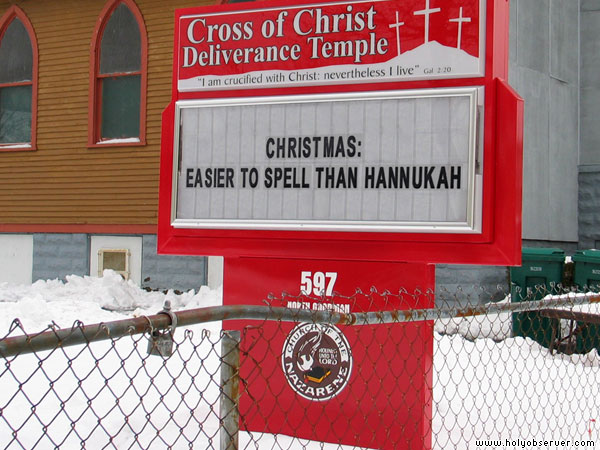
I don't know that the "Christians" at thischurch would agree.
In my undergraduate studies, I minored in Religion. Of the courses I took, and remember, one that stood out as being of particular importance, even sacred, to my 80+ year old professor was Sermon Preparation. He instilled the tried and true, three points and a poem (think alliteration), Baptist style of hermeneutics. At the time I thought it a little over the top, but in light of the readings, I agree that there is something substantially valuable and, in a way, sacred in the tradition of Christian exegesis.
Montesano, Mark "Kairos and Kerygma: The Rhetoric of Christian Proclamation." Rhetoric Society Quarterly 25 (1995): 164-178.